What people mean by a traditional doctor
"Traditional doctor" and "traditional healer" are, for most people using them, the same thing. Both point to someone who works within African traditional practice rather than within clinical medicine. Which phrase someone reaches for usually depends on where they grew up, what language they are translating from, and who taught them the word.
Dr Salongo Hamuza describes himself as a professional traditional healer. He answers to "traditional doctor" as well, because it is what a great many people call the work — but the description he uses for his own practice is traditional and spiritual consultation.
The word "doctor" in this context carries no claim to a medical qualification, and it is not used here to suggest one. It is a term of respect in ordinary Ugandan speech for someone who holds traditional knowledge.
Herbs and traditional preparations
Much of the work rests on plants. Leaves, roots and bark are gathered fresh and prepared in the way they have been prepared in this part of Uganda for generations. Which plants are used, and how they are prepared, is knowledge held locally and learned over a long time.
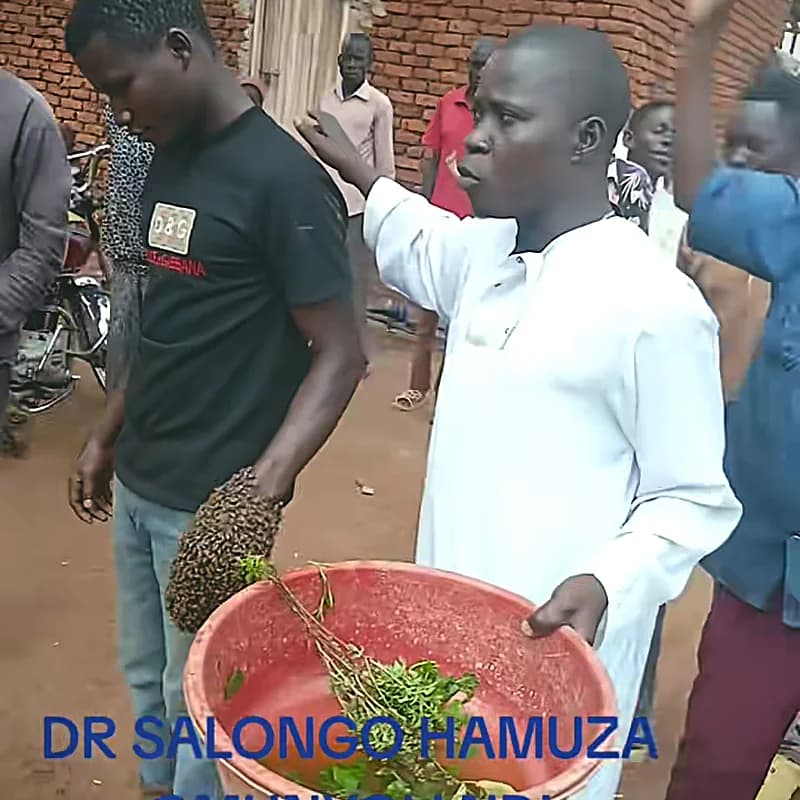
The preparation is not hidden. It happens in the open, in front of whoever has come, and much of the footage published on this website was filmed exactly where that work takes place rather than staged afterwards.
Traditional preparations are part of traditional practice. They are not prescribed medicines, they are not a substitute for prescribed medicines, and nothing prepared in a traditional consultation should be taken as a replacement for treatment a doctor has given you.
The matters people bring
People arrive with the difficulties of ordinary life rather than with a list of symptoms. A traditional consultation is usually about a situation — something that has gone wrong, or stalled, or become impossible to explain — rather than about a diagnosis.
- Relationships, marriages and matters within a household
- Work, trade, and businesses that have stopped moving
- Progress in a career, including in uniformed and public service
- Fertility and family matters, carried privately and often for years
- Children, schooling and concentration
- Travel, documents and journeys that keep failing
- Property lost or taken, and matters never resolved
- Protection of a home, a family or a place of work
Carrying the Herbs Through the Trading Centre — filmed during traditional work in Uganda.
A traditional doctor is not a medical doctor
This needs saying plainly. A medical doctor is trained, examined and licensed to diagnose and treat illness. A traditional doctor is not, and Dr Salongo Hamuza makes no such claim.
Traditional and spiritual consultation is offered as guidance rooted in traditional belief and practice. It does not diagnose, treat or cure any medical condition. Anyone experiencing a serious physical or mental-health condition should seek qualified medical care, and should continue any treatment a doctor has prescribed.
Where a matter brought to a consultation belongs with a hospital, the police, a school or a lawyer, that is said plainly and without hesitation. No specific outcome, cure or financial gain is promised or guaranteed.
What a visitor can expect
Nothing is assumed about you before you have spoken. A consultation begins with you describing the situation in your own words, for as long as you need, and no photograph, name or account is published without your permission.
You will be told what any guidance involves before it begins, in language you understand. You are not asked to leave your own beliefs at the door — people come from many faiths and backgrounds — and you are never asked to do anything unlawful or anything that would cause harm to another person.